The AI Enablement Brief · Sep 30, 2026
Two Personal Agents in 30 Days. Who Do You Trust With Your Data?
Grok Bot and Meta Muse are built for completely different people. The choice between them comes down to one question.
I started testing out Meta Muse over the weekend, and I wanted to share some thoughts, because there’s a clear direction in which the industry is heading.
Two always-on personal agents have launched in the last 30 days. They both live in the cloud, and they both do real work for you. On paper they’re in the same category. In practice they’re built for completely different people, and putting them side by side says a lot about where this is going.
Built for the Builders
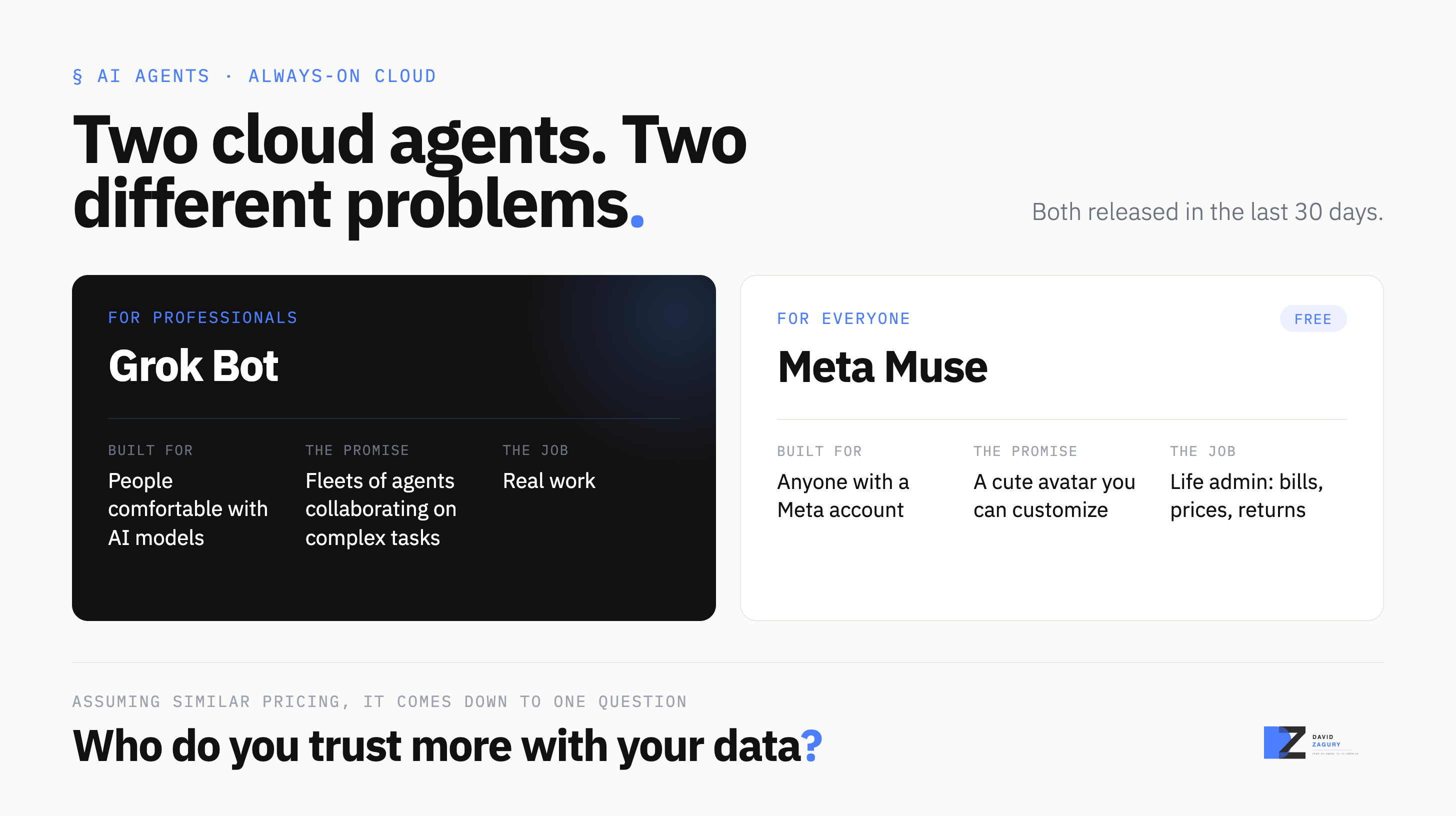
Grok Bot was released a little over a month ago. The promise was to be able to build fleets of AI agents doing real work for you, with your bots collaborating on complex tasks. It’s aimed at professionals who are somewhat comfortable with AI models.
I’ve been running it since launch. In Build the Team, Not the Bot, I wrote about how accessible the setup is: an account, a few MCPs, a few prompts, and you have something working in under 15 minutes. I run around 10 bots that collaborate all day and report back to me. But the real work happens after setup, when you design the team: who is on it, what their titles are, how they hand work to each other. That’s a professional’s tool. It rewards people who already think in workflows and are willing to put in the hours to get the fleet right.
Built for Everyone Else
Then you have Meta Muse, which is the exact opposite of this.
It’s aimed at everyone. Mass market. Extremely easy to use and set up for anyone who has a Meta account. It also lives in the cloud and is able to do real work for you, but the positioning is aimed at life admin: paying bills, tracking prices online, dealing with product returns. Things that most people struggle with and would be more than happy delegating to a cute avatar they can customize.
That’s a very different pitch. Grok Bot sells capability to people who already want it. Meta Muse sells relief to people who never asked for an agent in the first place, and it meets them where they already are, inside an app they open every day.
Both are great solutions, but solving different problems.
The Kicker
nd here’s the kicker: Meta Muse is free. Which isn’t surprising, because Meta is in the business of selling customer data.
I’ve written about this pattern before. In The High Price of Free AI, the argument was that free AI is paid for with your data, and that the data becomes the moat. In ChatGPT Ads: The Audience Problem, the numbers showed that 81% of ChatGPT users are on the free tier, which is exactly the audience ads are built for. Meta Muse takes that model one step further. A chatbot hears what you ask it. An agent that pays your bills, tracks the prices you care about and handles your returns sees what you buy, what you owe and what you almost bought.
The Switching Cost of Context
Now, these 2 platforms were released in the last 30 days, and I wouldn’t be surprised if Claude or OpenAI come up with their own version of an always-on cloud agent for the general population at some point.
On my side, I still have my AI agents wired through Claude on Telegram. But the reality is that every new tool or platform that comes out comes with a high switching cost. You spend months building context, sharing important information, and it’s tempting to always chase the new tool.
That context is the part people underestimate. In Context Engineering Is a Fancy Word for Judgement, I wrote that the hardest thing to nail down when building agents is giving them the right context. Once you’ve done that work, it lives inside one ecosystem. It doesn’t export cleanly into the next shiny launch. And in The Model Question, I made the case that the model you pick barely matters compared to integration and context. Personal agents raise the stakes on that, because the context isn’t a brand guide or a reporting template anymore. It’s your life.
That being said, you still have to be able to use the right tool for the right task.
What to Do With This
Match the agent to the job. Grok Bot and Meta Muse are built for different people. If you want a team that does professional work, you need something built for fleets. If you want your returns handled and your bills paid, a mass-market agent might do it with far less effort. Be honest about which problem you’re actually solving before you pick.
Count your context before you switch. Before moving to the next launch, list what your current setup knows: the instructions, the files, the history, the preferences you’ve built up over months. If you can’t bring it with you, that cost belongs in the decision.
Ask who’s paying. If an agent is free, figure out how the company makes money. With Meta, that answer is already public. Use it if it helps, but decide which parts of your life you hand it.
Decide on trust first, features second. If Claude or OpenAI ship their own version, the features will start to look similar. The difference will be how each company treats what its agent learns about you.
Ultimately, assuming similar pricing, the choice of ecosystem you buy into comes down to one question only.
Who do you trust more with your data?
Thanks for reading The AI Enablement Brief!
Join the 1% of marketers who bridge the gap between AI tools and actual business results.