The AI Enablement Brief · May 7, 2026
The Terminal Era of Media Buying
Meta just opened its ad stack to Claude and ChatGPT. The next decade of marketing won't be won inside dashboards.
Last week, Meta opened its ad stack to Claude and ChatGPT.
Through MCP — the Model Context Protocol — any AI assistant that supports MCP can now create and manage Meta campaigns directly. No switching tools. No clicking around Ads Manager. Just a conversation with your AI of choice that can act on the platform.
If you spend most of your time in marketing tooling, you might have scrolled past this announcement. It looked like a developer story. It isn’t.
It’s the moment MCP stopped being a developer protocol and became a marketing standard.
What MCP Actually Is
A quick layer-set, in case you’ve avoided this rabbit hole.
MCP — Model Context Protocol — is an open standard that lets AI assistants talk to external tools and systems through a consistent interface. Anthropic introduced it. Since then, it’s quietly become the way AI agents do anything beyond chat — read your files, query your databases, send messages, run code. Think of it as USB for AI: you plug an assistant into a tool, and they can work together.
Until recently, MCP servers were mostly built by and for developers. The applications were technical: read this codebase, manage this Linux server, query this Postgres database.
Meta’s announcement changes the audience. The MCP server connecting Claude or ChatGPT to Meta Ads isn’t built for engineers.
It’s built for marketers — for the people running the campaigns. And once a major adtech platform exposes itself this way, every other one is on the clock.
The Pattern Across Vendors
This isn’t an isolated event. It’s the latest in a wave.
Adobe rebuilt Experience Cloud around persistent AI “Coworkers.” Salesforce shipped Agentforce Operations to break back-office workflows into agent-handled tasks. OpenAI launched Workspace Agents in ChatGPT to gather context, follow team processes, and act across systems. All within the last three weeks.
These look like separate product launches. They’re the same product launch, made by different vendors, pointed at the same destination.
The destination: a workflow where you stop opening individual platforms to do work, and start having conversations with an AI that does the work across all of them. The AI is the interface. The platforms become the back-end.
Meta’s MCP move is the marketing-specific version. Once it’s normal to manage Meta campaigns through Claude, the question becomes: why am I still opening a different dashboard for Google Ads? For TikTok? For LinkedIn?
You’re not. Soon enough, you’re managing all of them from one terminal session, talking to an AI that orchestrates the whole stack.
The Workflow Inversion
Here’s what actually changes about the day-to-day for someone in paid media.
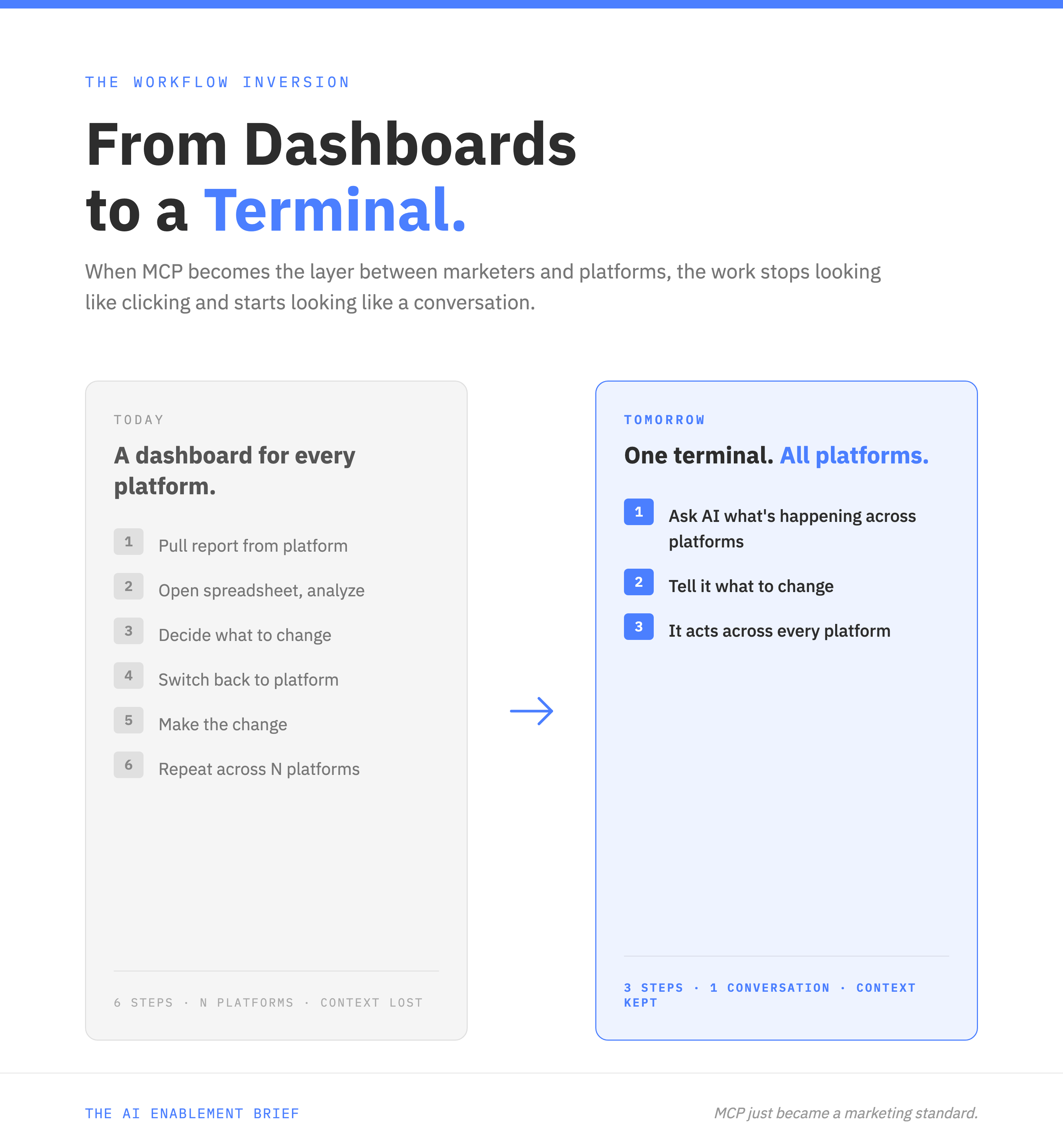
Today, the workflow is: pull report from platform → analyze in spreadsheet → decide what to change → go back to platform → make the change → repeat across N platforms. The friction is the tool-switching. The cognitive cost is keeping the context straight in your head between tabs.
Tomorrow’s workflow is: open your AI assistant of choice → ask it what’s happening across your platforms → get a synthesized answer → tell it what to change → it makes the change. One context. One conversation. Multiple platforms acting in parallel.
The dashboard doesn’t disappear. It just stops being where you spend your time. It becomes what your AI checks on your behalf.
The marketer’s job shifts in the same direction every other knowledge worker’s job is shifting: from clicking around tools to directing systems that do.
What to Do This Month
If this resonates and you’re not sure where to start, three concrete moves.
First, install Claude Desktop or another MCP-capable client. Get used to the idea that your AI assistant can actually do things, not just answer questions. The mental model shift happens the first time you watch it edit a real file or hit a real API on your behalf.
Second, find one MCP server for a platform you actually use. The Meta connector is the marketing-specific one in the news, but there are MCP servers for analytics tools, CRMs, data warehouses, and content platforms. Pick one that touches something in your daily work. Connect it. Run a real query through it.
Third, run one real campaign or workflow through the MCP-driven interface. Not a test. A real one. Document what worked, what broke, what was faster, what you missed about the dashboard. That’s the muscle.
The marketers who win the next five years won’t be the ones with the best targeting playbook. They’ll be the ones who built this muscle while it still felt optional.
It won’t feel optional much longer.
The terminal era of media buying isn’t a 2027 prediction.
It’s a 2026 starting point.
The only question is whether you want to learn it now, or be told to learn it later.