The AI Enablement Brief · Jun 8, 2026
The Foundation Stays Manual
I automated the rest of the financial agent. The one piece I kept by hand is the one piece you'd expect to automate first.
One of the most useful AI agents I built this year is by far my financial agent.
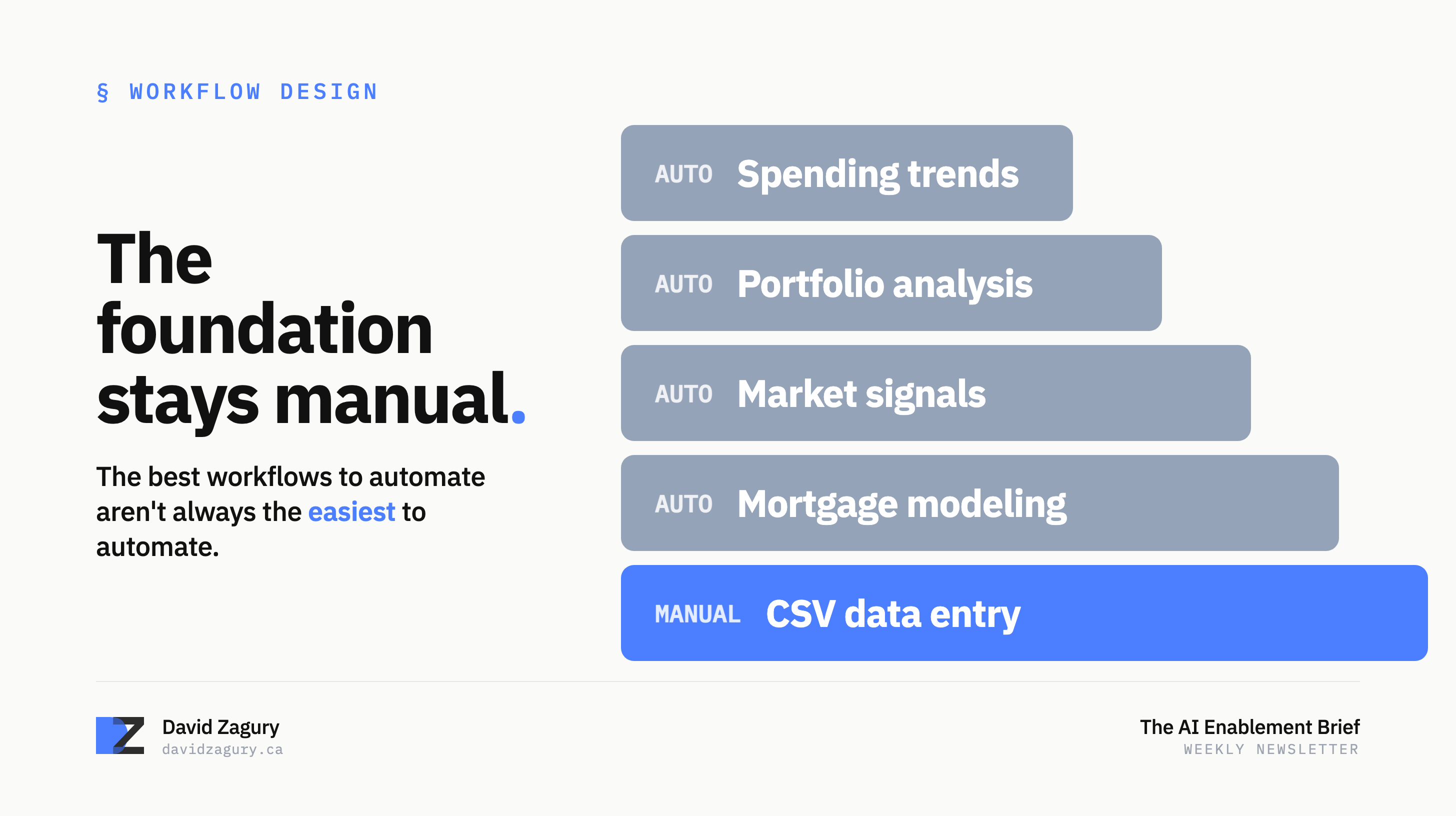
It surfaces spending trends, analyzes my investment portfolio and recommends adjustments based on real market signals, and runs financial analysis and modeling. It was actually super useful when I renewed my mortgage recently.
The whole system is automated. It has access to financial APIs to monitor the stock market in real time, connects to my calendar to book earnings calls with predictions versus actual performance, and reads my financial data from my Google Drive.
It runs continuously. It updates on its own.
Except for one thing.
The One Step I Didn’t Automate
The data entry.
Every month, I copy and paste CSVs from my bank accounts into my master file. Manually. Whole process takes less than 15 minutes.
It sounds like the obvious thing to automate. Easy to automate. Repetitive enough to make sense. If you were sketching this workflow on a whiteboard, the data entry box would be the first one you’d reach for.
It’s the most boring step in the stack and it has the cleanest input-output shape. Of course you’d ship the bot for that first.
I still do it by hand. On purpose.
Why the Foundation Stays Human
Because the data entry is the most critical part of this whole agent. If the data is wrong, or if hallucinations slip in, none of the insights downstream really matter.
This is financial analysis. The agent isn’t generating vibes about my portfolio. It’s recommending real adjustments based on real numbers. If the inputs are off, the agent isn’t slightly wrong. It’s confidently, articulately, completely wrong. And I’m the one acting on that output.
So I automated the entire stack except the one step where being wrong matters most.
The 15 minutes isn’t waste. It’s what makes the rest of the agent trustworthy. If the foundation isn’t clean, the analysis is built on sand, and the AI surfaces confident recommendations from broken data. The asymmetry is huge: I save fifteen minutes by automating, and I pay for that with one bad financial decision based on a hallucinated number that looked like all the others on the page.
The Inverse Workflow Question
Most of the AI workflow conversation is about what to automate. Pick the highest-leverage, lowest-skill, most repetitive thing and ship.
The inverse question almost never gets asked. What do you intentionally keep human, even when automating would be cheap and obvious?
For me, the answer was the data entry. For someone else’s workflow, it might be a different step. The shape of the answer is the same: the step where you can’t tell if it went wrong is the step that should stay human, even if it’s the easiest one to automate.
That’s the hidden cost of “let’s automate everything.” Some steps look like obvious automation candidates because they’re tedious. They’re tedious for a reason. The tedium is the carefulness.
The Work to Start Now
If you’re building AI workflows, run two passes on your map of the work.
First pass: what’s the most time-consuming step? That’s your automation candidate.
Second pass: what’s the step where you can’t tell if it went wrong? Keep that human.
These are usually not the same step. When they overlap, you’ve found a workflow that AI shouldn’t run end-to-end yet. Build the rest of the stack around the human step, not over it.
So here I am, a few days into the month, copying and pasting financial data. Making sure the foundation is clean and accurate.
Sometimes the best workflows to automate aren’t necessarily the easiest to automate.