The AI Enablement Brief · Aug 28, 2026
AI Still Changed How I Write.
There's a difference between a writing tool and a thinking partner. Only one of them is worth having.
Earlier this year I set a rule for myself: publish something every week. Here on the newsletter, and on LinkedIn. No skipped weeks, no “I’ll double up next week.”
I haven’t missed one yet.
The second rule came right after. And it’s the one people find strange, given what I do for a living. I don’t use AI to write my content. I write all of it organically, inside Notion, typing every word.
That sounds like a contradiction coming from someone who spends his days building AI workflows for an agency and its clients. It isn’t. It’s the reason the rule exists.
Thinking Partner, Not Ghostwriter
The reason I don’t hand the writing over isn’t precious. It’s practical.
When I write a piece myself, I find out what I actually think. The argument gets tested somewhere between the second and third paragraph. And about a third of the time it falls apart, so I write something better instead. That process is the value. If I outsource it, I get a publishable article and learn nothing.
So AI comes in somewhere else entirely. I use it to nail down the storyline. The arc. Where the piece should end, and what the hook should be. It’s the conversation I’d have with a smart colleague before I start typing. The typing stays mine.
That distinction gets lost in most of the “AI for content” advice out there. The tools are pitched as a way to skip the work. The far better use is to sharpen the thinking that makes the work worth reading.
The Interview Trick
The most useful thing I’ve built for this doesn’t write a single sentence for me.
It’s a command I use called /riff. It pulls from recent news signals in my space, then interviews me. Open-ended questions, almost like a podcast host would: what have you been working on, what do you make of this thing that just happened, why does that matter.
I answer. Out loud, usually. And somewhere in the answering I find the piece.
Writer’s block, for me, was never a shortage of ideas. It was a shortage of prompts good enough to pull them out. A blank page asks you nothing.
That’s why the interview format works better than any “generate five blog post ideas” prompt I’ve tried. Ideas generated for me are someone else’s. Ideas dragged out of me by a good question are mine. And they show up in the writing that way.
From the Desk to the Sidewalk
For most of this year, writing looked like what writing has always looked like. Me at a desk, at a laptop, typing.
I’d batch it. Three or four articles in one sitting, then publish them over the following weeks. That’s how the streak survived busy months — the work was already done.
More recently the whole thing moved off the desk.
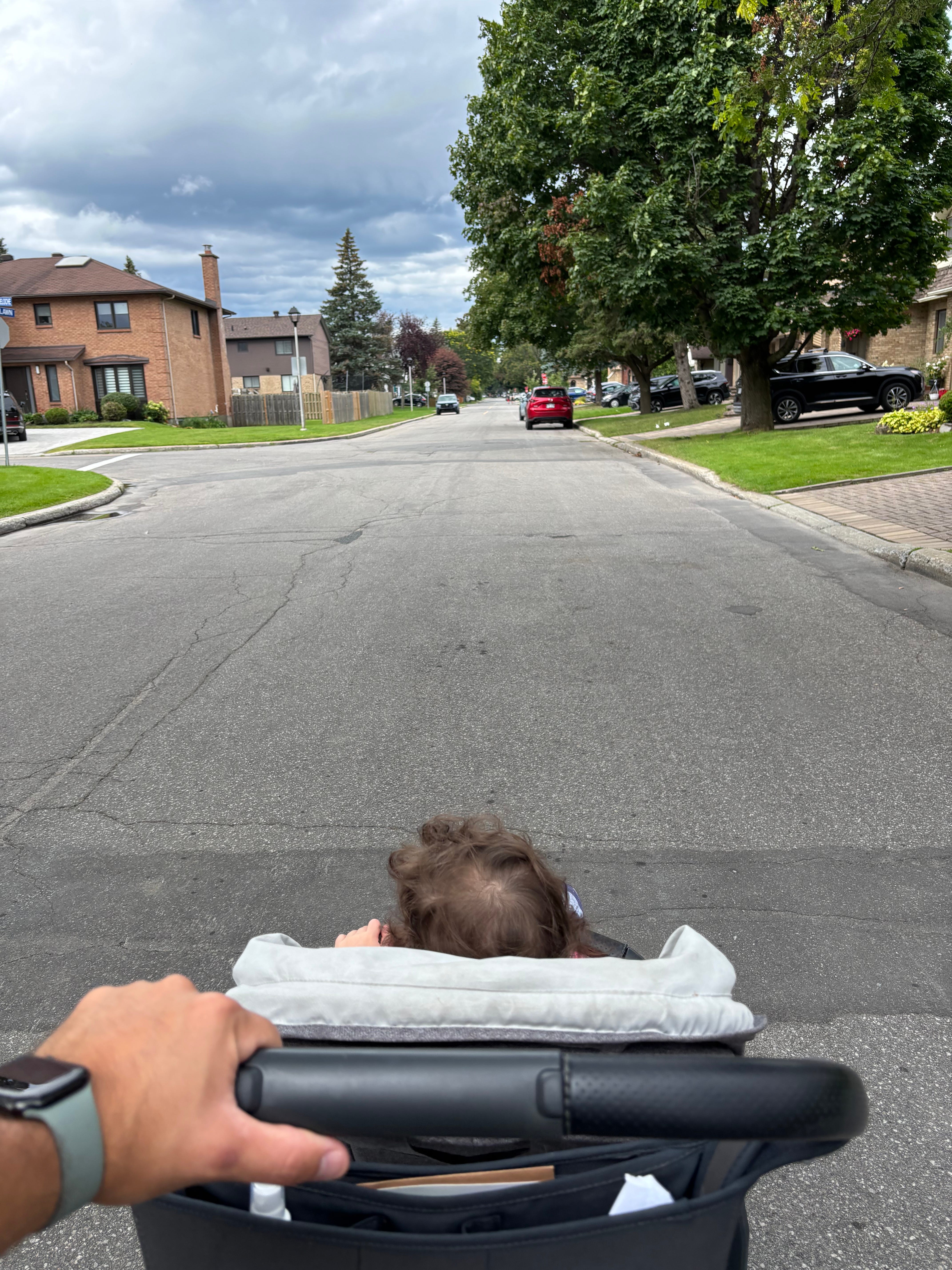
Now I go for a walk, usually pushing my daughter in her stroller, and I dictate with Wispr Flow. One walk gets me an article. Sometimes two or three. Then I take the raw dictation into my regular production routine and shape it from there.
The time saving is real, but it’s not the reason I switched. Talking and typing produce different writing. When I type, I edit while I compose. So the result comes out flatter and more careful than I want. When I talk, the sentences show up closer to how I’d actually say them. Which happens to be the voice I’m trying to write in anyway.
The other part matters more. It’s less time sitting at a desk and more time walking with my daughter. That’s not a productivity hack. That’s just a better hour.
What to Steal From This
If you want to build something similar, start with the order. The tools come second.
Protect the thinking, automate around it. Decide which part of your work you’d keep even if a machine could do it tomorrow, and point the AI at everything except that. For me it’s the writing itself. For you it might be the analysis, the client call, the design pass.
Replace the blank page with a question. You don’t need a custom command to start. Ask an AI to interview you about your week, with follow-ups, and refuse to let it summarize. Answer out loud. The transcript is your raw material.
Separate capture from composition. Most people’s bottleneck isn’t ideas, it’s the sitting down. Dictation moves capture into time you already have — a walk, a commute, the twenty minutes before the house wakes up. Composition can wait until you’re at a desk.
Batch when the well is full. Three articles in one good session beats one article a week in three mediocre ones. Consistency is a supply problem, not a discipline problem.
Keep the human tell. The typos I fix, the phrasings I keep because they sound like me, the arguments that changed shape halfway through — that’s the part people are actually subscribing to.
The Part Worth Keeping
We’ll all spend the next few years deciding which parts of our work to hand over. Most of that will be the right call. A lot of it is drudgery we should have automated years ago.
But some of it is the work that makes the job worth doing. And that part rarely looks precious from the outside. Writing looks like output. For me it’s thinking with a keyboard attached.
I’ll keep every tool that helps me think better and get the words down faster. The words themselves stay mine.
That’s the trade I’m making.