The AI Enablement Brief · Feb 16, 2026
Why Systems Beat Willpower
I hit my goal of publishing 3x per week for 30 days. Here is the exact system that made it happen.
I hit my goal of writing and publishing content 3 times per week for 30 days.
When I set this over the holidays, I actually thought it was too ambitious. I kept wondering: How the heck will I come up with three original pieces every single week?
I worried that by week two, the well would run dry and I’d be staring at a blinking cursor, hunting for a “topic” just to fill the calendar.
But that was exactly the point.
The real goal wasn’t the publishing. It was to develop my content ideation muscle.
The writing and publishing were just the process to help me get there. By forcing the output, I forced the input—and my brain finally started looking at the world through the lens of “what’s the briefing here?” instead of just consuming information passively.
The Ideation Shift
I’ve realized I actually enjoy the research, writing, and editing that comes with it. There’s a specific satisfaction in taking a complex AI update and stripping it down to what actually matters for marketing.
And even though I could technically automate the entire thing with AI—from ideation to publishing—I don’t.
I use AI very sparingly and intentionally. If you automate the thinking, you lose the “enablement” part of the brief. Here is how I stay consistent without losing the human intuition that makes the work valuable:
Filter the Noise: Use AI to read and summarize, not to think or feel. It’s a research assistant, not a ghostwriter.
The Raw Work: True insight happens when the work is still 90% good enough. This is where the struggle lives, and that struggle is what builds the muscle.
The Sunday Batch: I do most of my writing on a Sunday for the week ahead. It’s about finding the windows in between family time, training, and other activities to get the bulk of the heavy lifting done.
Human Intention: Systems handle the schedule and the data-gathering, but I handle the “why.” If there’s no human intention, it’s just more digital clutter.
The Intentional AI Framework
To achieve 100% consistency without sacrificing quality, I built a specific four-stage process that removes the friction of “starting from zero.”
1. Understanding Trends and News
AI moves too fast to keep up with it manually. If you try to catch every headline, you’ll never have time to write.
Daily Recaps: I have Gemini deliver a recap of AI and marketing news twice per day. It filters out the hype-cycle fluff and product launches that don’t matter, so I only get the signal I actually need to stay informed.
X Scanning: Another Gemini automation scans X daily for top conversations. I don’t spend much time there, so this saves me from “doomscrolling” while keeping me inspired by what the smartest people in the field are actually talking about.
2. The 90% Rule
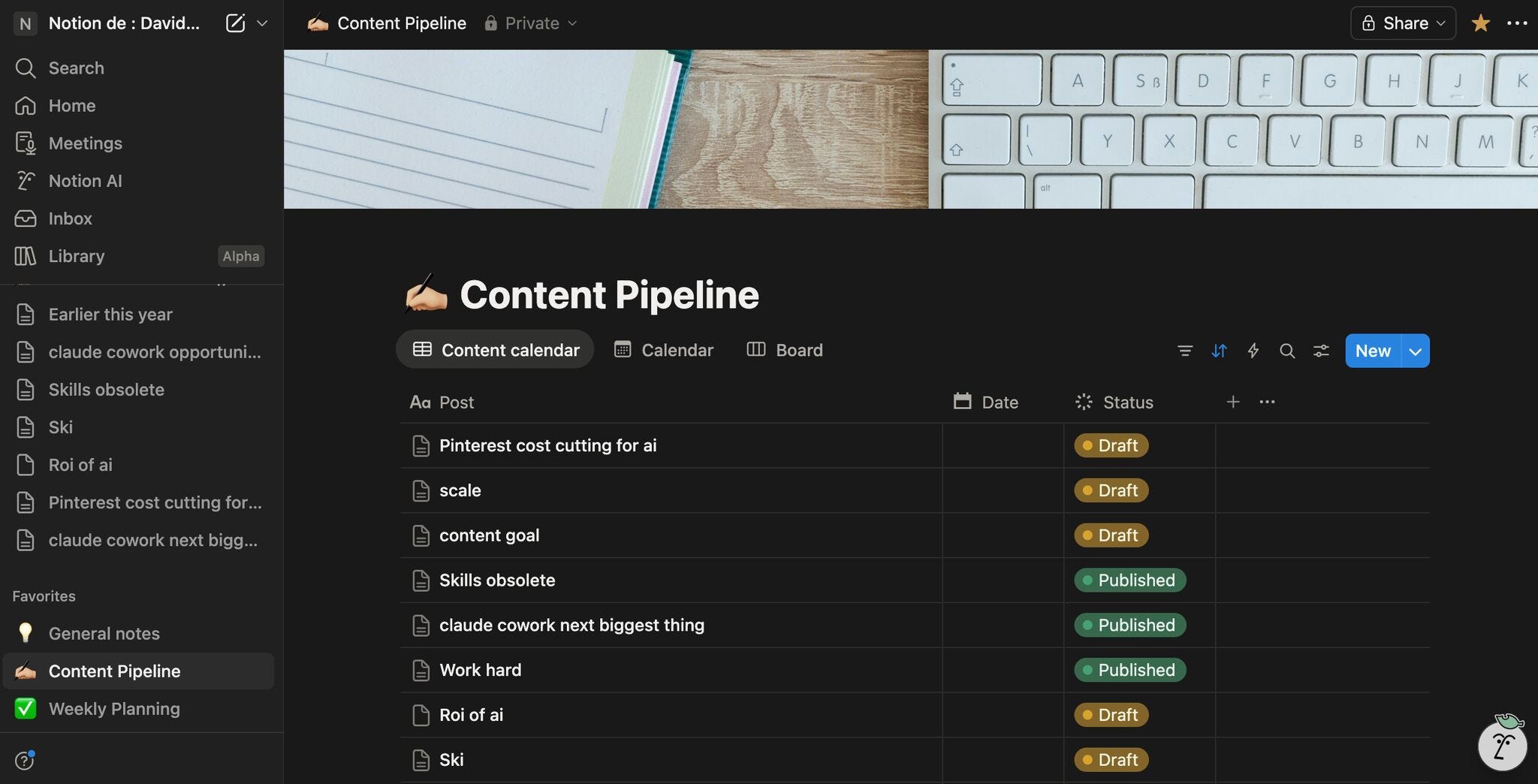
I use Notion to store every idea that sparks during the research phase. I often capture these ideas on the go—wherever I am—and then expand on them at my computer later.
I write my full content in Notion until it is about 90% “good enough.” This is the raw work—the thoughts, the bullet points, and the core arguments. It’s not pretty, and the grammar might be a mess, but the soul of the piece is there. I don’t let AI touch this stage because this is where the actual learning happens.
3. The Custom Edit
Once the core thinking is done, I use custom Gemini Gems to edit the text using my own voice. This is the “polishing” phase. It helps me find the right closing and nail the storytelling—sometimes my raw notes lack the right story arc or the transitions feel clunky. It doesn’t write for me; it acts as a high-level editor that knows exactly how I like to phrase things.
4. Manual Publishing
The final step is always manual. I handle the posting on LinkedIn and Substack myself. This is my final “quality gate.” Reading the post one last time as I paste it into the editor ensures that I stand behind every word. It’s the accountability check that keeps the work authentic.
Systems help us stay consistent. They prevent the “blank page” syndrome and keep us moving when motivation fails. But the intention behind the work? That has to stay human.
Keep building the muscle.