The AI Enablement Brief · Mar 20, 2026
The Workflow Stack
The AI workflows that save the most time aren't the ones you'd expect.
Last Friday afternoon, I spent an hour building an AI workflow for a client.
Not a creative strategy engine. Not a content generator. A reporting workflow. It pulls campaign data from multiple sources, formats it into the structure our team uses, and delivers a clean report — ready for review, not ready for revision.
One hour of building. Over 100 hours saved per year for the team.
It wasn’t glamorous. Nobody’s posting “I automated a report” on LinkedIn. But it was the single most impactful workflow I’ve built in months.
And it made me rethink how we prioritize what to automate in the first place.
The Pull of the Shiny Thing
When most of us think about AI workflows, we think big. Strategy assistants. Creative brainstorm tools. Campaign planners that take a brief and spit out a full media plan.
I get it. That’s the exciting stuff. It’s also where the demos live — the “look what AI can do” moments that make everyone lean forward in a meeting.
But here’s what I’ve learned after building dozens of these workflows across our agency: the exciting ones rarely stick.
They require too much oversight, too much correction, and too much context that’s hard to codify. You build them, demo them, and then three weeks later nobody’s using them because the output needs so much editing it would’ve been faster to start from scratch.
The boring workflows? Those are the ones that quietly become indispensable.
The Workflow Stack
I’ve started thinking about this as a stack — three layers, each with a different relationship between effort and impact.
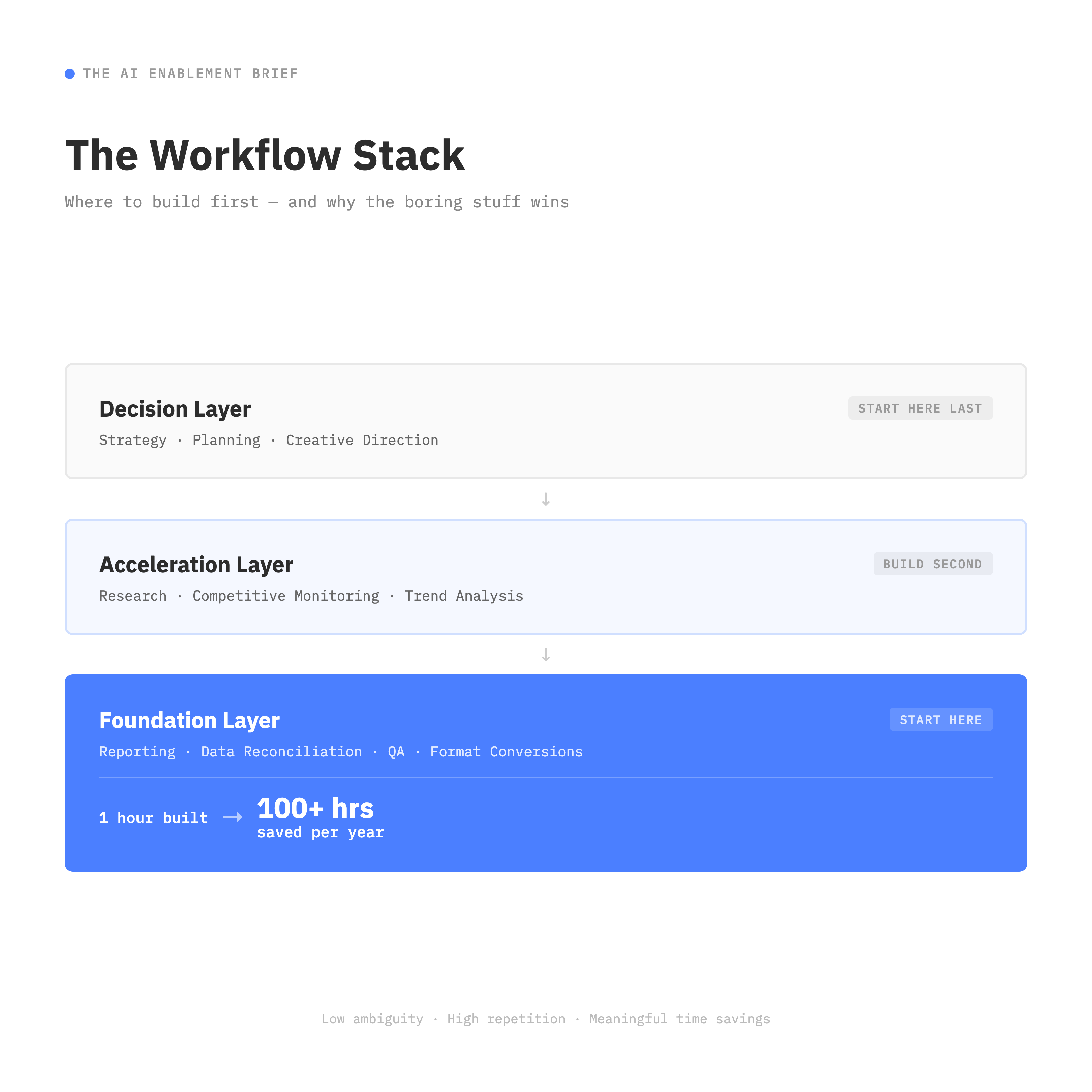
The Foundation Layer sits at the bottom. Reporting. Data reconciliation. QA checks. Format conversions. The invisible, repetitive work that eats hours every week but never shows up in a strategy deck. These workflows are simple to build because the inputs and outputs are well-defined. There’s less ambiguity, which means less room for AI to drift. And the time savings compound immediately — every week, every client, every cycle.
The Acceleration Layer sits in the middle. Competitive monitoring. Research synthesis. Trend analysis. Brief assembly. These workflows don’t replace a task — they speed up a process. They give you better inputs for the decisions you’re already making. The catch is they only work well if you trust the data underneath them. Which is why the Foundation Layer matters so much.
The Decision Layer sits at the top. Strategy recommendations. Creative direction. Campaign planning. This is where AI is least reliable and where the stakes are highest. It’s not that you can’t build workflows here — it’s that they require so much human judgment to validate that the “automation” part becomes almost secondary.
The pattern I keep seeing: teams that start at the top get disillusioned. Teams that start at the bottom build momentum.
Why the Bottom of the Stack Compounds
There’s a compounding effect that’s easy to miss when you’re focused on the flashy stuff.
When your reporting is automated, your team spends less time formatting spreadsheets and more time actually reading the data. When your data reconciliation is handled, you catch discrepancies before they become client conversations. When your QA checks run automatically, you ship cleaner work with less back-and-forth.
None of that sounds revolutionary. But it frees up something that is: attention. And attention is what you need for the higher layers of the stack to actually work.
The Acceleration Layer gets better when your team isn’t burned out from manual reporting. The Decision Layer gets better when the research feeding it is consistent and current. The stack builds on itself — but only if the foundation is solid.
Where to Start
If you’re wondering where to build your first workflow — or your next one — here’s the question I’d ask: what does your team do every week that requires almost no judgment but takes meaningful time?
That’s your Foundation Layer. Start there.
For us, it was reporting. For your team, it might be data pulls, status updates, format conversions, or client-facing QA. The specifics matter less than the principle: low ambiguity, high repetition, meaningful time savings.
Once the foundation is solid, the middle of the stack starts to feel obvious. You’ll see the patterns — the research you do before every campaign, the competitive scan you run before every pitch. Those are your Acceleration Layer candidates.
The Decision Layer? It’ll get its turn. But by the time you get there, you’ll have built the trust and the data infrastructure to make it actually useful.
Start There
We spent months trying to automate the exciting parts of our work. The real impact was waiting in the parts we barely thought about.
One hour on a Friday afternoon taught me that. The best workflow you’ll build this year probably isn’t the one you’re imagining right now.
It’s the boring one.