The AI Enablement Brief · Mar 4, 2026
The Evolution of Discovery: From SEO to GEO
Why the fundamentals of search haven't changed, even as the metrics disappear.
We’ve been talking about AEO, AIO, and everything in between and it looks like the industry is finally reaching a consensus with GEO—Generative Engine Optimization.
While the terminology feels new, the core logic isn’t.
It doesn’t differ that much from the fundamentals that have made SEO valuable for three decades.
SEO was about building authority and nailing the technical foundation.
GEO focuses on these exact same things. We just call it something else. But while the input remains similar, the output—and how we measure it—has shifted entirely.
Metrics for a Zero-Visit Reality
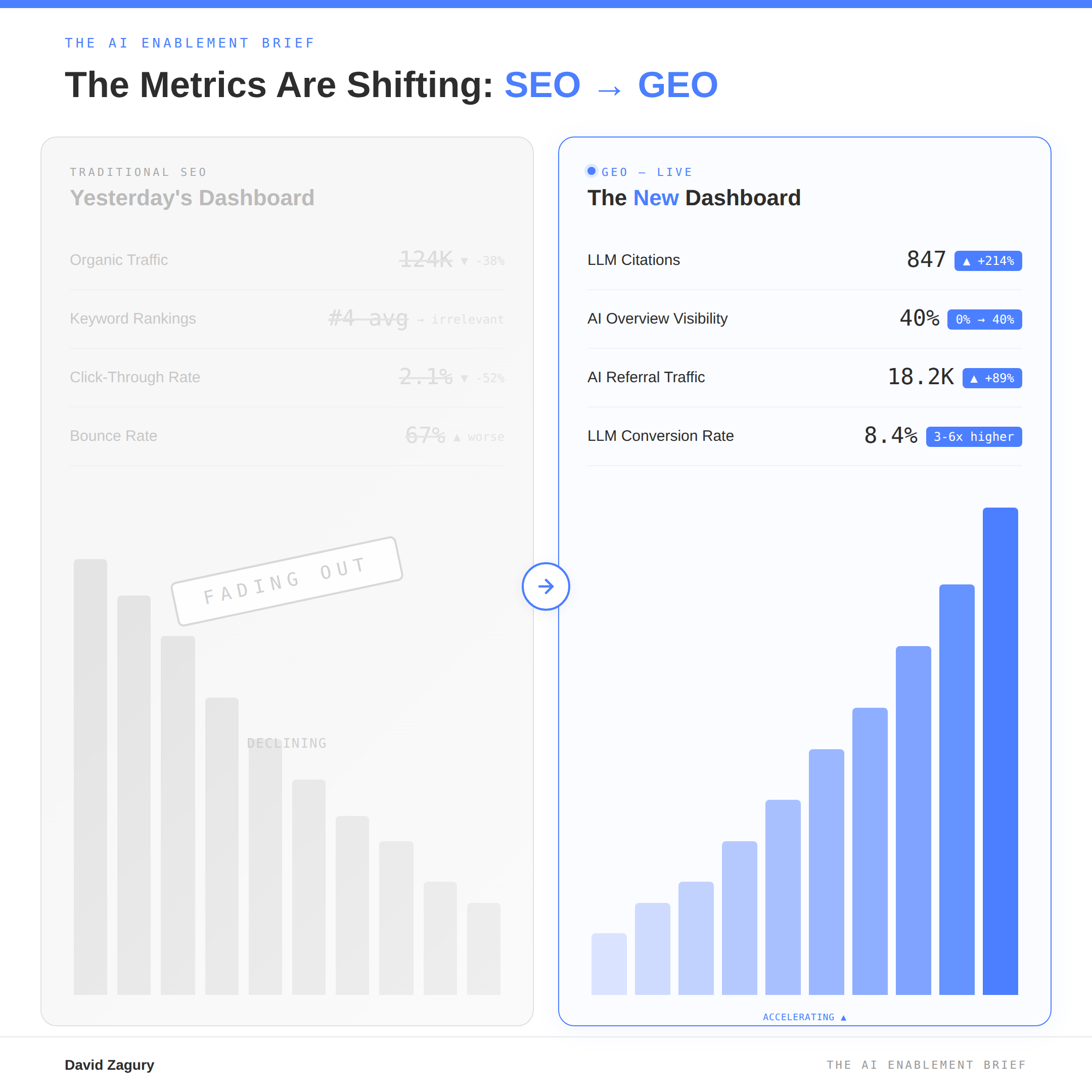
SEO success was traditionally measured by organic traffic, click-through rates, and blue-link rankings.
These metrics will soon vanish from every reporting dashboard as the industry is moving toward LLM citations and referral traffic.
And that reality is accelerating:
The “AI Mode” Shift: Google recently tweaked its model so the “See More” button redirects mobile users into a conversational workflow. This isn’t just a UI change; it’s a behavior shift.
The Barrier: This effectively removes the ability to scroll past the AI answer to see organic results. Once a user enters “AI Mode,” they are no longer browsing a list of links; they are interrogating a model.
The Reality: For broad informational queries, we are officially entering a “Zero-Visit” reality. If the AI provides the answer, the user has no incentive to click through to your site. Your “ranking” only matters if you are the source the AI is quoting.
The Discovery Foundation Model
Building for the age of GEO requires a fundamental pivot toward technical visibility and high-intent authority.
Structured Data (The Visibility Jump): According to new data from Schema App, pages with proper structured data are seeing jumps from 0% to 40% visibility in AI Overviews within weeks. LLMs don’t “read” your website like a human; they parse it like a database. If your content isn’t “machine-readable” through backend Schema, you are functionally invisible to the discovery engines of 2026.
Video as Authority: YouTube is a core GEO pillar. Nearly 30% of AI overviews now cite YT videos as their primary source for how-to and demonstration queries. In a world of hallucinating text, the AI treats video as “proof” of expertise. If you aren’t showing the “how-to” on camera, you are ceding authority to those who are.
Intent-Based Conversion: Expect a 3x to 6x higher conversion rate from LLM-referred users compared to traditional search. Why? Because these users are entering the funnel much further along in the decision-making process. By the time an AI refers a user to your site, it has already done the “comparison shopping” for them. The user isn’t arriving to browse; they are arriving to execute.
The game is changing, but the principles aren’t. Authority and technical clarity still win.
Don’t get distracted by the noise—focus on the foundation.
How much of your 2026 strategy is built on metrics that are about to disappear?