The AI Enablement Brief · Apr 10, 2026
The Data Moat
SaaS isn't dying. It's splitting in two — and the line between them is proprietary data.
I used to think the complexity was the point.
In the early days of building Mediaplan, I was running outbound through Apollo.
Finding ideal customer profiles, setting up sequences, drafting personalized messages, configuring targeting, managing reply threads. The whole operation was elaborate — multiple tabs, multiple steps, a workflow I had to rebuild every time someone touched it.
I didn’t question it. That’s what software was. You learned it, you adapted your process to fit it, and you paid monthly for the privilege.
Then I started building with Claude Code.
The Cron That Changes Everything
What I’ve replaced isn’t just a tool. It’s the assumption underneath the tool — that software needs to have buttons.
The outbound workflow that used to live across Apollo, a sequence builder, and a spreadsheet now runs inside Claude Code on a cron. While I sleep. No login required. No predefined user flow. Just plain language, logic and context.
The first time it ran without me touching it, I sat with that for a minute.
The experience wasn’t “this is faster.” It was “why did I ever accept the other way?”
That’s a different feeling. And it’s one I can’t unfeel when I open almost any SaaS product now. Navigating traditional software today feels clunky in a way it never did before. Not because the software got worse. Because my reference point changed.
The SaaSpocalypse Has Two Flavors
Here’s what I think happens next — and I want to be specific, because the narrative usually collapses into “AI kills SaaS.” That’s too blunt.
SaaS is splitting in two, and the split is clean.
On one side: products that are essentially workflow wrappers. A clean UI on top of generic functionality. Email sequencing. Task management. Basic analytics dashboards. These products provided value by making a process easy to do inside a predefined system. But if I can describe that process in plain language and have an agent execute it — the friction they were solving for is gone. The product was always the interface, not the intelligence. And interfaces are getting disintermediated.
On the other side: products that sit on top of proprietary data. Your CRM has ten years of customer interactions. Your analytics platform has transaction history that exists nowhere else. Your HR system holds workforce data that no model was trained on. The value was never the UI — it was the data underneath. Those products have a defensible future. Not an easy one, but a real one.
SaaS products with no proprietary data are going to struggle in the next 1-5 years. There’s no friction left worth paying for.
The Catalog Model
The survival path for the second group is also a transformation.
If I can pull what I need from an API rather than navigating a complex system, I will. If I can send an agent to query your data directly and synthesize it, I don’t need your dashboard. I don’t need your reports tab. I don’t need your onboarding checklist.
What I need is the data.
Shopify actually just released their AI toolkit yesterday, allowing users to manage their store with an agent like Claude Code, directly from any CLI.
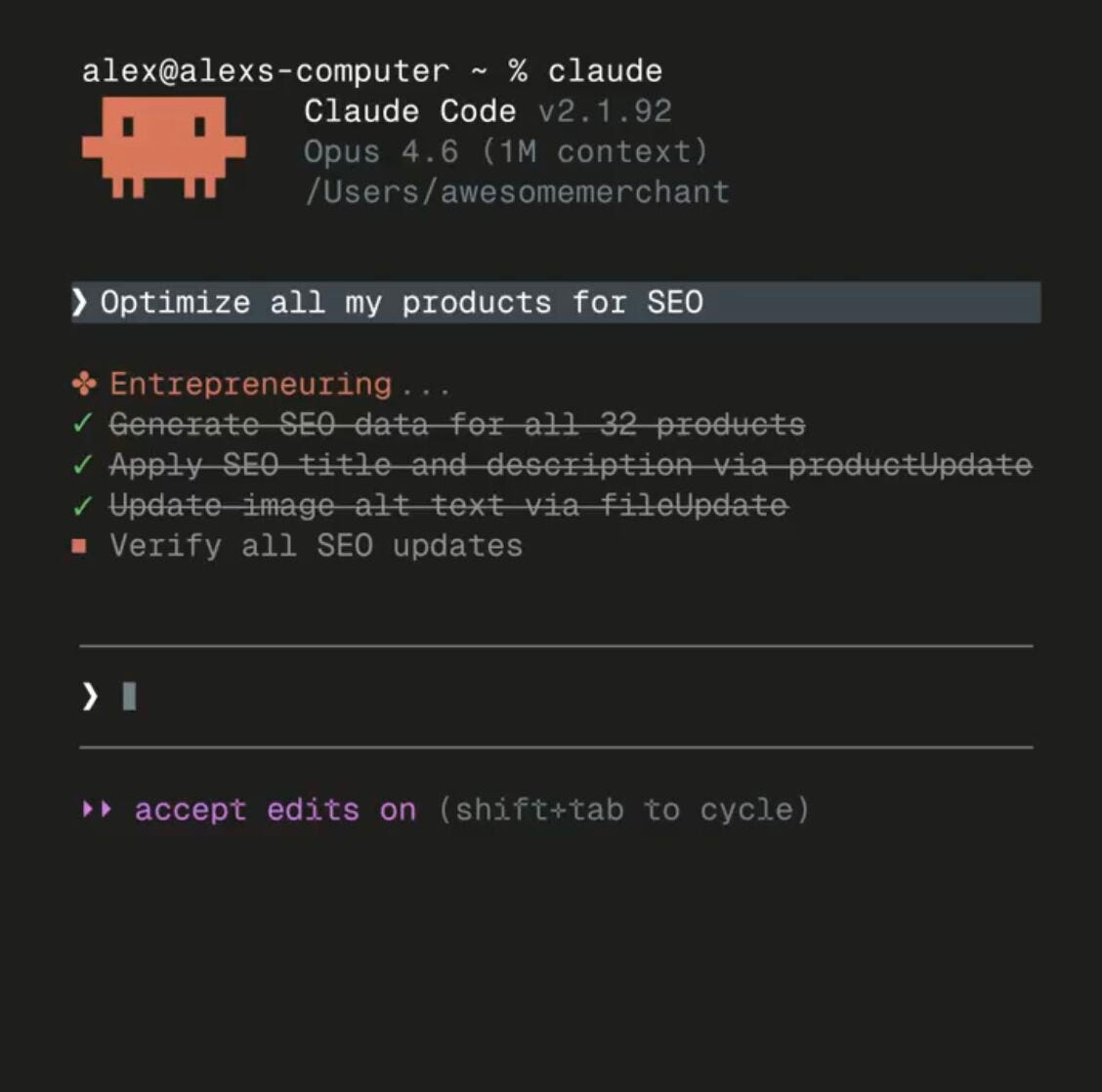
So the software becomes the product catalog — a structured, queryable source of something I can’t get anywhere else. And the data becomes the moat. The business model shifts from charging per seat (paying for access to a UI) to charging per token (paying for access to the intelligence).
That’s not a small change. It’s a complete renegotiation of what software is for.
What To Watch For In Your Stack
This isn’t a prediction about five years from now. It’s already happening, in small ways, across every category.
Ask yourself about the SaaS products you’re paying for today: if the UI disappeared tomorrow and you could only access this product via API, would you still pay for it?
If yes — there’s real data underneath, something proprietary that nothing else has — you’re dealing with a company that has a future. Their job now is to open the API and let you, or your agents, pull from it directly.
If no — if the product is essentially a nice interface on top of something you could rebuild in plain language — you’re watching a slow substitution in progress. The timeline is 1-5 years. The direction is clear.
The builders who understand this shift early will stop evaluating software by features and start evaluating it by data. Not “what can this tool do?” but “what does this tool know that nothing else does?”
That’s the game now.