The AI Enablement Brief · Apr 7, 2026
The Baseline Caveat
The "AI replaces jobs" narrative is missing the most important variable.
Last week I wrote on X that the thoughts of “we need more people” and “this is going to take time” should be over by now.
The responses were split. Some people agreed. Others pushed back hard. And honestly? Both sides had a point — because the statement is incomplete without a caveat nobody’s talking about.
It assumes baseline performance.
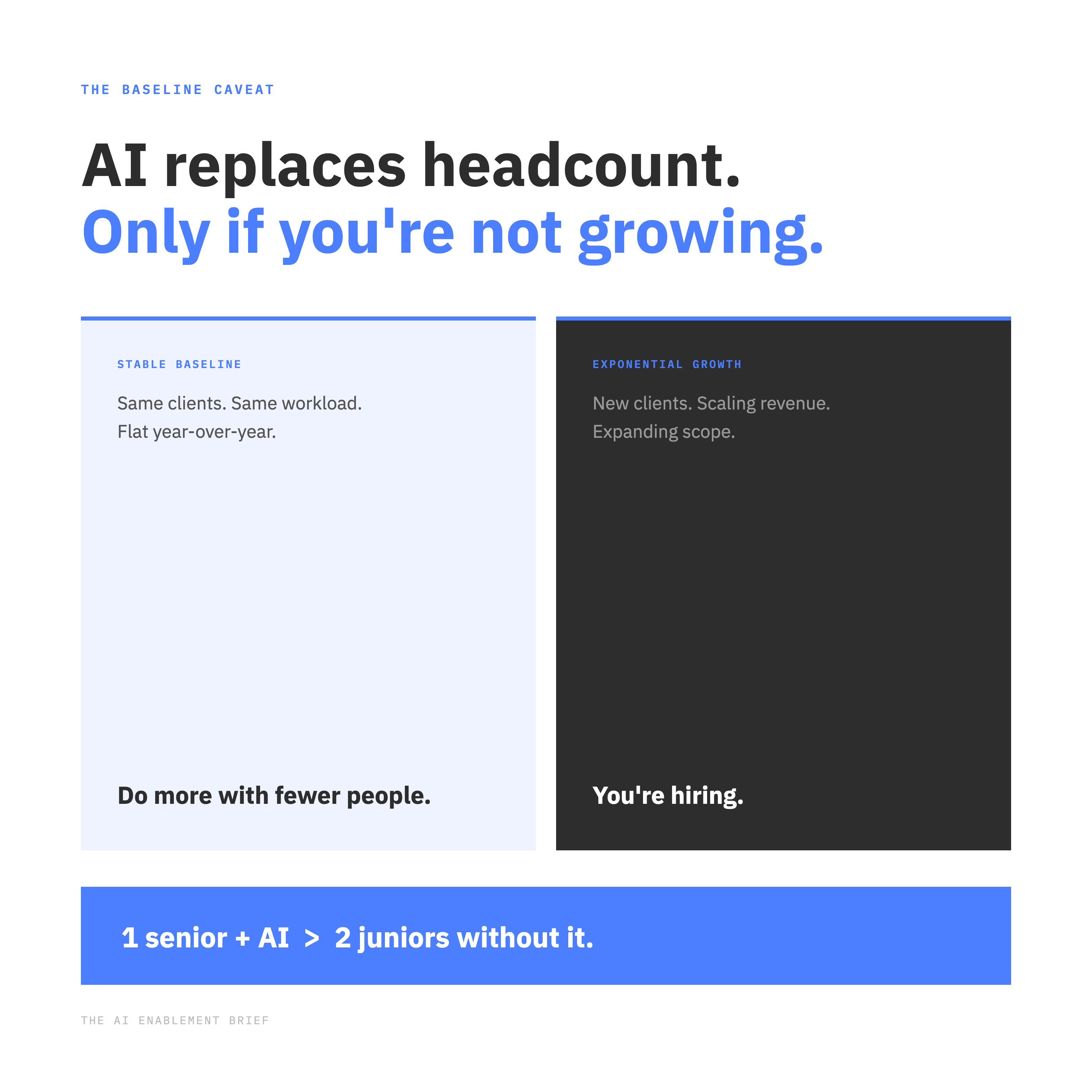
Stable growth. Same clients. Same workload. Not scaling mode. Not exponential growth.
If your company is operating at that baseline, then yes — your team should be able to do the same amount of work in less time with AI. Or produce significantly more in the same hours. That’s not a prediction. That’s already happening.
PwC’s 2025 Global AI Jobs Barometer found that productivity growth has nearly quadrupled in industries most exposed to AI, jumping from 7% to 27% over a six-year period. Revenue per employee in those industries is growing 3x faster than in the least exposed sectors.
But the minute you start growing exponentially? You’re hiring. That’s a different conversation entirely. If NP Digital wins a $100M client, we’re hiring across paid media, SEO, client services, and more. No amount of AI changes the physics of scaling a services business into a major new account.
The nuance matters because most of the discourse treats this as binary. AI replaces all jobs, or it doesn’t. The reality is more conditional than either side wants to admit.
The Decathlon Test
I lived this before AI existed in the workflow. At Decathlon, we had a fifteen-person engineering team at capacity. My own digital team — paid media, SEO and CRM — was stretched thin. We weren’t growing substantially. Stable year-over-year. And every conversation was the same: we need more people, we need more time.
So we hired.
That was the right call for that moment. But here’s what’s changed: today, if we were having those same conversations at the same growth rate, the answer would look completely different.
Stable performance, someone walks in and says “we need three more heads” — you better have a really solid case. Because AI can do a lot of that work now.
The Decathlon version of me was a content specialist and SEO specialist. Today, one person with AI fluency covers ground that used to require two or three. Not because the work disappeared — because the throughput per person changed.
The New Hiring Equation
This is where it gets personal for anyone in a hiring seat — or anyone looking at their own career.
I’d rather hire one expensive senior person who’s supercharged on AI than two juniors who aren’t using it. That’s not a philosophical stance. It’s math. One senior person with deep domain knowledge and strong AI skills doesn’t just do more work — they do different work. They know what to delegate to AI and what to hold. They know when the output is wrong. They know which shortcuts are actually shortcuts and which ones create debt.
The data backs this up. Jobs requiring AI skills now command a 56% wage premium over similar roles that don’t — up from 25% just a year ago.
Meanwhile, the skills employers are looking for are changing 66% faster in AI-exposed occupations. The market is already pricing in what most teams haven’t acknowledged yet: AI fluency isn’t a nice-to-have. It’s the variable that determines how much a person can actually produce.
The Compounding Advantage
Here’s what most people miss about this shift. AI skills don’t just make you faster at your current job. They compound over time. Every workflow you automate, every agent you build, every process you rethink — it stacks. Six months of intentional AI fluency doesn’t make you 10% better. It makes you categorically different from someone who hasn’t started.
Subject matter expertise coupled with exceptional AI skills makes you dangerous. It makes you unstoppable.
That’s not hyperbole. It’s the market reality. AI job postings are 134% above 2020 levels while total job postings are essentially flat. The demand isn’t for people who can use ChatGPT. It’s for people who understand their domain deeply enough to know where AI actually moves the needle — and where it doesn’t.
What This Means for You
If you’re a hiring manager: stop defaulting to headcount as the solution for capacity problems. Ask whether you’re at baseline or in growth mode. If it’s baseline, the answer might be AI enablement for your existing team, not a new hire. If it’s genuine growth, hire — but hire people who are already AI-fluent.
If you’re an individual contributor: the biggest unlock you can make right now is becoming an AI expert within your domain.
Not a general AI enthusiast. Not someone who follows the news. Someone who has built workflows, tested tools, and knows where AI creates real leverage in your specific function.
That’s the biggest unlock anyone can make right now.