The AI Enablement Brief · Mar 13, 2026
The AI That Doesn't Wait
Part 1 of 3 — The agent era isn't coming. It's already running.
Earlier this week, I connected Base44’s new Superagents to my Google Search Console.
Set a goal: scan underperforming content, surface recommendations, draft the changes.
It ran in an instant. Told me what I had to fix, then pushed the updates live.
That moment broke something in my mental model. Not because the technology is magic — but because of what it revealed about everything we’ve been doing with AI until now.
The Reactive Wall
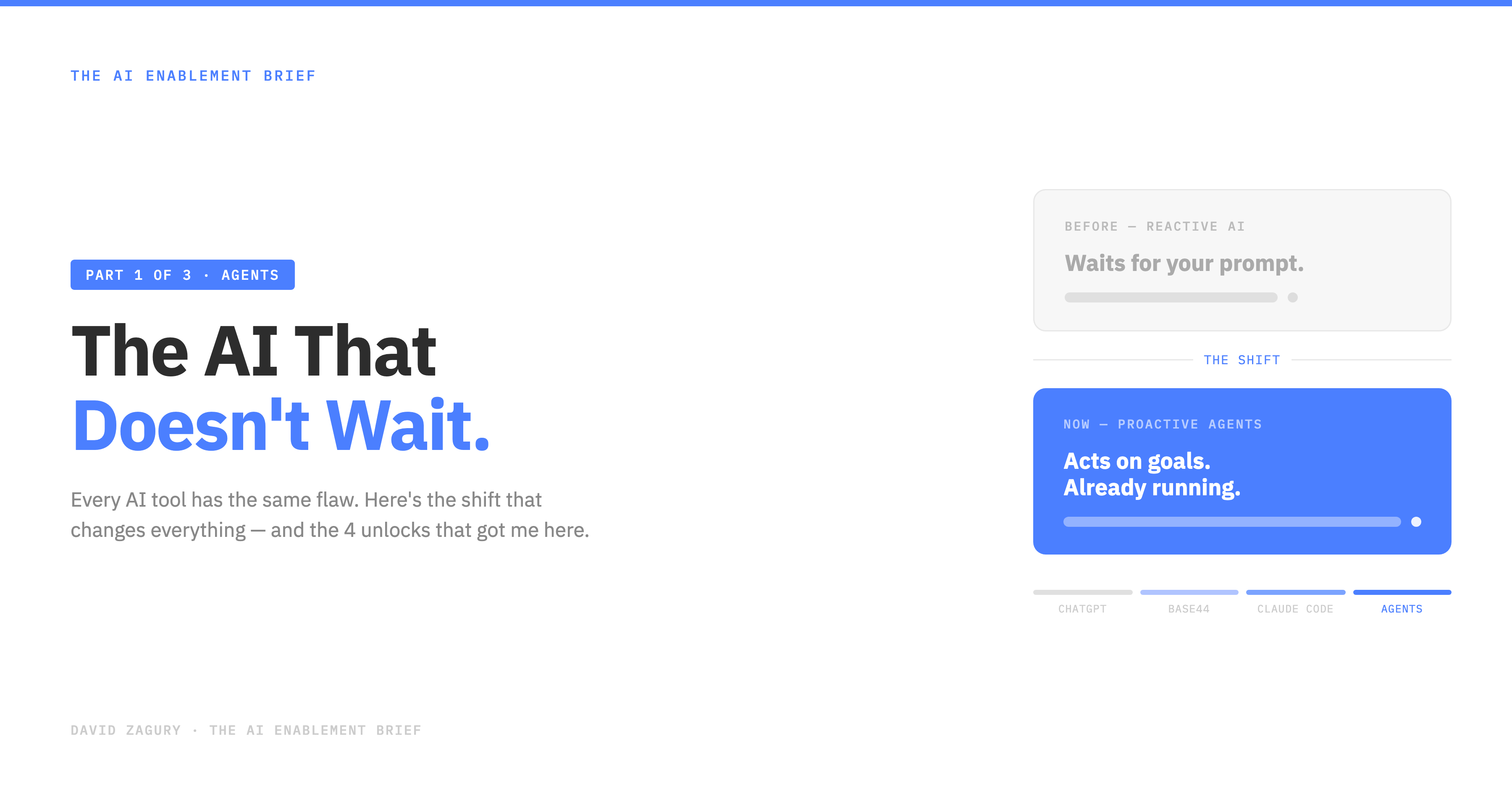
Here’s the thing about every AI tool we’ve been talking about for the past three years: they all wait for you.
You open a chat window. You write a prompt. You review the output. You refine. You go back and forth.
The AI doesn’t act until you ask. You lead. It follows. Every single time.
That’s not a flaw — it’s how those tools were designed. ChatGPT, Gemini, Claude in a browser window — they’re reactive by nature. Brilliant, useful, and fundamentally waiting.
Agents cross a different threshold.
An agent isn’t a tool that responds to prompts. It’s a system that acts on goals — browsing, clicking, drafting, sending, publishing, without you needing to initiate every step.
The difference feels subtle until you experience it. Then it’s impossible to unsee.
According to McKinsey, knowledge workers spend an average of 28% of their week just managing email and coordination. Not doing the actual work — managing the coordination around the work.
That’s the gap agents are designed to absorb.
The Four Unlocks
I’ve been thinking about this as a series of personal unlocks — moments where AI changed what was actually possible for me, not in theory, but in practice.
Unlock 1: ChatGPT and Gemini. The first time I could ask a question and get a real, useful answer. Generate content in seconds. Interact with information in a fundamentally new way. Revolutionary at the time. Still reactive.
Unlock 2: Base44 app builder. The moment I built mediaplan.ca from scratch — a real platform — without a traditional dev background. It opened my eyes to what AI-enabled building actually felt like.
Unlock 3: Claude Code and Cowork. Building systems instead of just using tools. Workflows that run indefinitely without me holding them together. The shift from prompting to building the engine.
Unlock 4: Agents. The technology acts on your behalf. Without being asked.
Each unlock didn’t just improve my productivity. It fundamentally changed the nature of my relationship with the technology. And this fourth one changes it the most.
The Morning Coffee Line
A few weeks ago, when OpenClaw arrived, I wrote about staying on the sidelines.
The promise was real. But so were the barriers: Mac minis, self-hosted infrastructure, technical setup that put it firmly out of reach for most people. I didn’t write it off — I watched and waited.
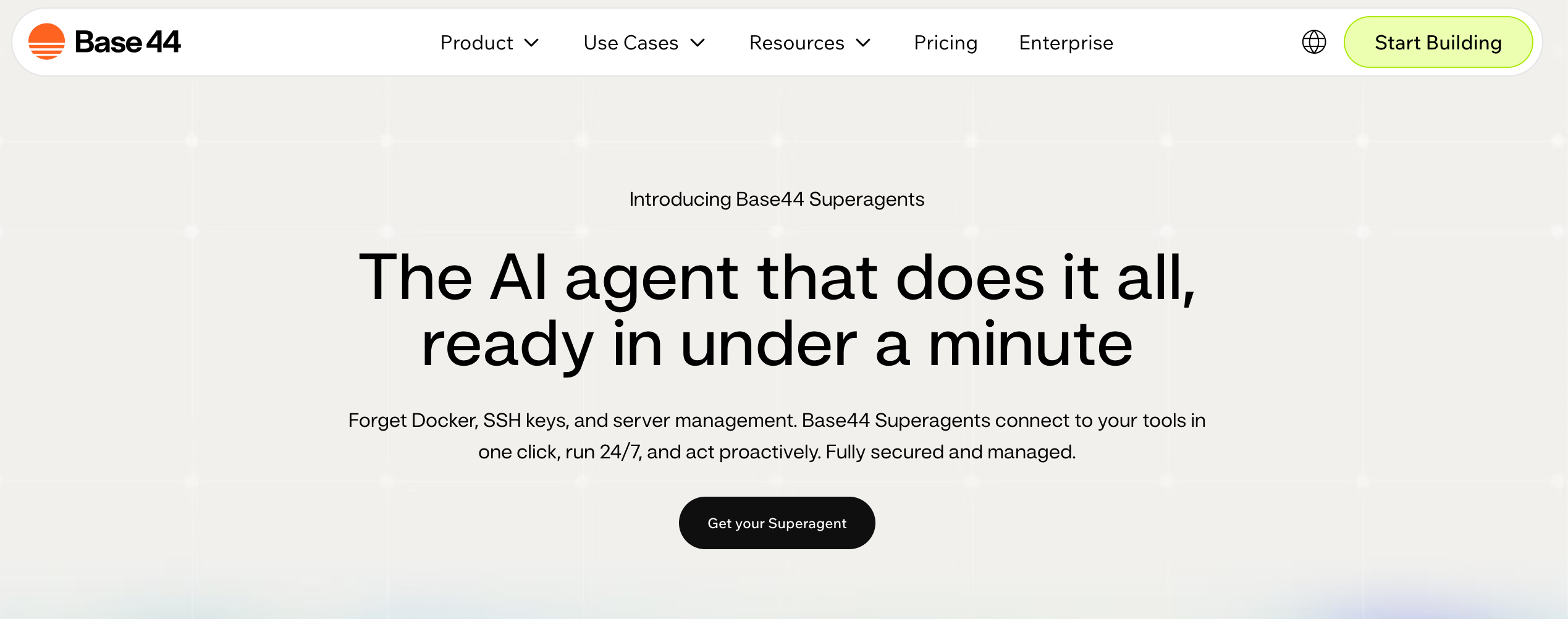
Base44 Superagents is what OpenClaw was trying to be, but accessible.
You connect it to your real tools — Google Drive, Notion, Slack, Search Console. You interact with it through WhatsApp or Telegram. No setup. No hardware. No friction. And it acts proactively, without waiting for a prompt.
That Search Console workflow? It doesn’t just find the problems — it can draft the fix and push it live. Before you’ve opened your laptop.
I’ve spent the last few days testing it. The simplicity floors me. The Base44 team shipped something technically complex in a way that feels effortless to use. That’s the hardest thing to pull off in software — and they pulled it off.
This is the democratization of the agent layer.
The Perplexity Signal
The day after Superagents launched, Perplexity announced their personal computer — an AI agent designed to run locally on a Mac mini. Fully secure. Always on. Working 24/7 on your behalf.
Different approach. Same direction.
Two companies, converging on the same idea at the same moment. When that happens, it’s not a coincidence. It’s a signal that the infrastructure is ready and the race to own the agent layer has started.
Gartner estimates that 33% of enterprise software applications will include agentic AI by 2028. We’re at the very beginning of that curve.
The Part That Stays With Me
I have two young kids.
I don’t spend a lot of time worrying about AI replacing workers — I’ve written about why that framing misses the point. The people building the mental models, the workflows, the judgment to work alongside these systems will have enormous leverage.
But I do think about pace.
ChatGPT launched in late 2022. Agents went mainstream in 2025. That’s less than three years from “here’s a chatbot” to “here’s a system that works while you sleep.”
My kids are going to enter a workforce that we genuinely cannot picture right now.
I’m not sure whether to find that terrifying or thrilling. Most days, it’s both.
What I do know is that the people who understand this technology from the inside — who’ve built with it, tested it, and rebuilt it — will be in a very different position than the people who engaged with it from a distance.
That’s why I’m still in the labs. Still testing. Still writing about what I find.

What’s Next
This is Part 1 of 3.
Next week: the exact workflows I’ve built using AI agents — what I set up, what worked, and what surprised me.
The week after: what this means for marketing teams still primarily using AI as a chat tool — and the gap that’s opening between organizations that have crossed the agent threshold and those that haven’t.
Are you already running agents — or still waiting to see how this plays out?