The AI Enablement Brief · May 1, 2026
The 4 Stages of AI Enablement
A simple curve every team sits on — and the gap that decides who actually compounds.
Most teams don’t have an AI problem.
They have an adoption problem.
The tools are already good enough. ChatGPT, Claude, the dozen vertical AI products your team already has tabs open to — they work.
What’s missing is the layer underneath: the workflows, the standards, the shared playbook that turn private experiments into team capability.
The data backs this up. A wave of Q1/Q2 2026 enterprise reports surfaced the same pattern: 97% of executives say their company has deployed AI agents in the past year.
But 79% face significant adoption challenges, and 62% don’t even know where to start. Deployment is everywhere. Outcomes aren’t.
That gap has a shape. Every team I’ve worked with sits somewhere on the same curve.
The Curve
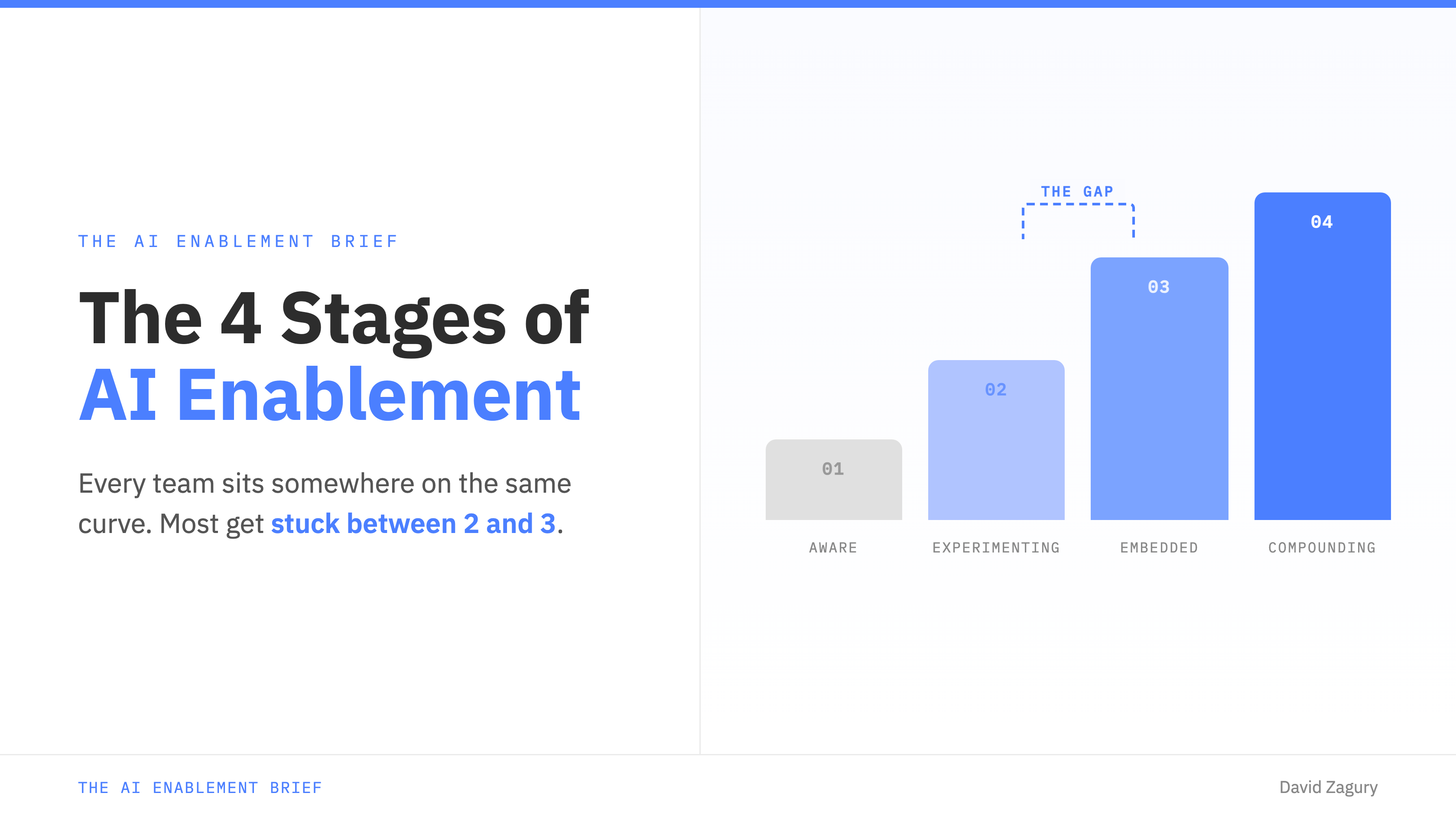
1. Aware. You know AI matters. You’ve read the posts, watched the demos, maybe tried ChatGPT once. Nothing has actually changed about how your team works. The conversation about AI is happening inside your organization, but it hasn’t shown up in any deliverable yet.
2. Experimenting. A few people on the team are using AI privately. One person is drafting copy faster. Another is using it for research. A third is messing around with custom GPTs on the weekend. Results are uneven. No one’s sharing what works. There’s no shared standard, no measurement, no playbook. The wins are real but they belong to individuals.
3. Embedded. AI is part of how specific workflows actually run. Prompts are standardized. Outputs are measured. New team members are onboarded into the system, not left to figure it out alone. The team has agreed on what AI is doing, what it isn’t doing, and how to evaluate the result. Private experiments have become team capability.
4. Compounding. This is the stage most people don’t realize exists. Capability stacks. Every new tool, every new model, every new team member gets absorbed faster because the adoption muscle exists. The team doesn’t have to relearn how to integrate AI every time something new drops — they have a process for it. They stop starting from zero every time.
The Distance Between 2 and 3
Most teams are stuck between 2 and 3.
The distance looks small. It isn’t.
Stage 2 to Stage 3 is the hardest jump on the curve, and it’s the one almost nobody talks about. Stage 1 to Stage 2 is easy — somebody on the team just opens ChatGPT. Stage 3 to Stage 4 is a maturity question — once the muscle exists, it grows.
But the move from “a few people are doing it privately” to “this is how we work as a team” requires something completely different from the work that got you to Stage 2. It requires translation. Standardization. Measurement. The boring, unsexy change-management work that nobody puts on a roadmap.
That’s the half of enablement most teams skip. (I wrote about this in The Two Halves of Enablement — the innovation work gets all the attention, the change management work is where most orgs stall.)
The fluency question — can we use the tools? — gets all the airtime.
The integration question — can the team actually do this together, repeatedly, in a way that compounds? — gets ignored. (That’s the maturity ladder I broke down in Beyond the Tool: The Three Levels of AI Maturity.)
That’s where the real enablement work happens.
How to Move
If you’ve recognized your team in this curve, the practical move depends on where you are.
If you’re at Stage 1, the move is just to start. Pick one workflow your team owns. Have someone use AI on it for two weeks. Document what happened. That’s how you get to Stage 2.
If you’re at Stage 2 — which is most people reading this — the move is harder and more important. You need to surface the private wins. Run a 30-minute session where everyone shares what they’ve tried. You’ll find that 80% of the wins overlap, and nobody knew. Pick the top three. Standardize the prompts. Define what “good” looks like. Make those three workflows the team default. That’s how you cross into Stage 3.
If you’re at Stage 3, the move is to build the absorption layer. When a new model drops, what’s your team’s process for evaluating it? When a new team member joins, how do they learn your AI workflows in 30 minutes instead of 30 days? When a new vertical tool gets pitched to you, who decides whether it slots in or stays out? Answer those three questions and you’re in Stage 4.
Stage 4 isn’t a destination. It’s a state where the cost of integrating new AI capability has gotten so low that the question stops being “should we adopt this?” and starts being “what should we add this week?”
Most teams won’t get there.
The ones that do won’t be the ones with the best tools.
They’ll be the ones who did the boring middle work nobody wanted to do.