The AI Enablement Brief · Apr 23, 2026
Claude Doesn't Just Build It. It Runs It.
What a weekend project taught me about where agentic AI actually lands — and why the first 48 hours were the least interesting part.
I spent last weekend building a fully custom website from the ground up using Claude Code.
Content, lead forms, custom tools. All of it live in under 48 hours.
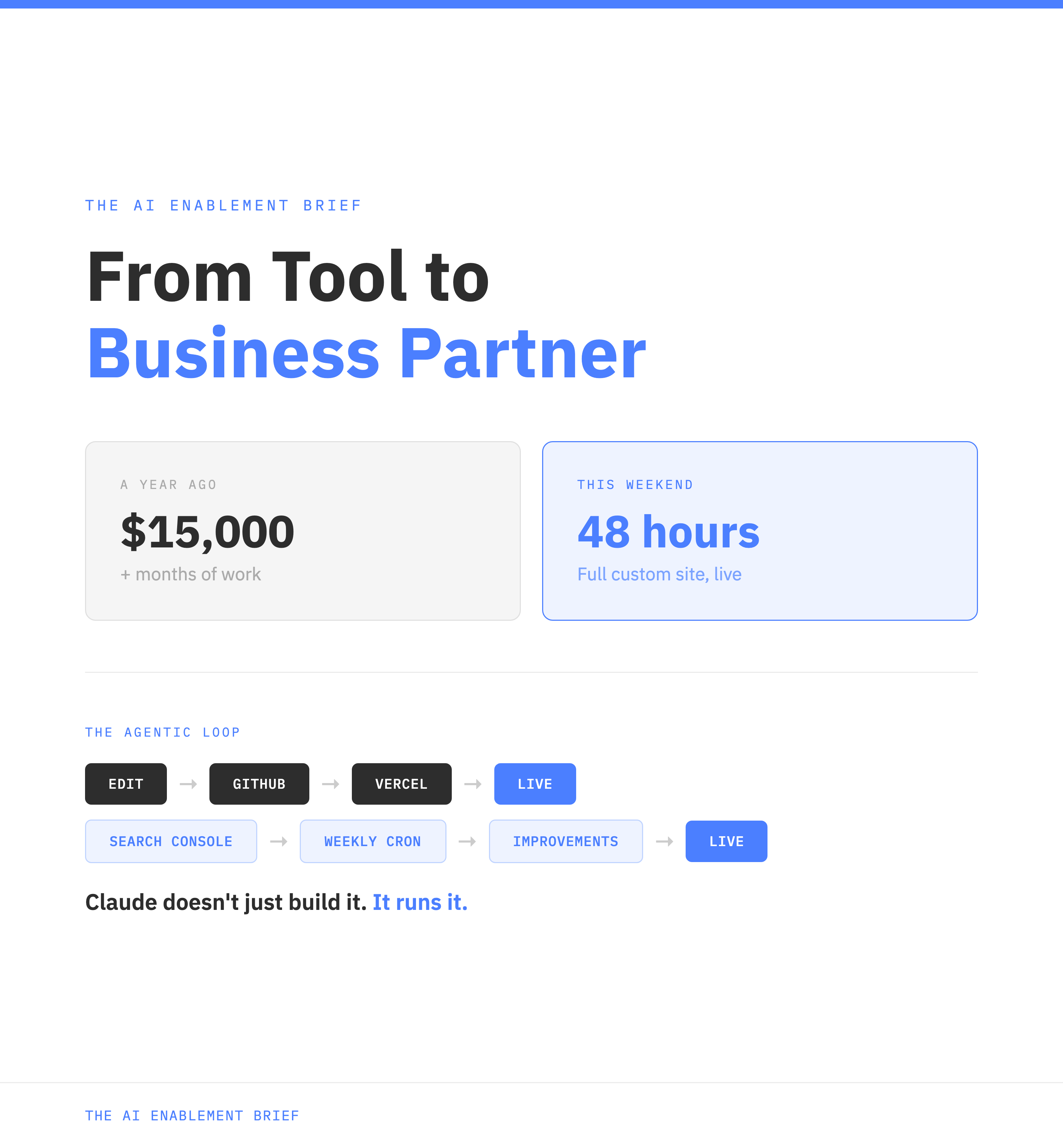
A year ago, this would have been a $15,000 project. Multiple contractors. Weeks of back and forth. A staging environment. Launch day stress. The kind of thing you scope, quote, and calendar months in advance.
I did it between Saturday morning and Sunday night.
But that’s not even the most interesting part.
The Build Wasn’t the Story
The site went live Sunday evening. By Monday morning, I had already moved on mentally — because the build itself, as fast as it was, felt almost beside the point.
The real shift happened when I connected the site to my Search Console and gave Claude Code access to my goals.
Now, every week, a cron job runs. It pulls my performance data, identifies gaps between where the site is and where I want it to go, recommends improvements, and pushes them live. All managed inside Claude Code. All without me initiating anything.
I didn’t just build a website. I built a system that makes the website better.
That distinction sounds subtle. It’s not.
The Business Partner Model
Here’s how I used to think about Claude Code: a powerful tool I reach for when I need something built. I prompt it, it builds, I review, I ship. Clean transaction. Done.
The website changed that framing entirely.
All of a sudden, Claude isn’t waiting for me to initiate. It’s an ongoing partner in a specific outcome — site performance — that it monitors, analyzes, and acts on week after week. The relationship went from reactive to continuous.
This is the real promise of agentic AI. Not faster task completion. Not better autocomplete. A fundamentally different model: from tool you use to partner that works alongside you.
Shopify already saw this coming. Their new AI toolkit lets merchants manage entire store operations from inside a terminal — not as a one-off action, but as an ongoing operating model. The question they’re implicitly asking merchants: do you want to run your store, or do you want to direct a system that runs it for you?
That question applies to every knowledge worker now.
The Human in the Loop Isn’t a Compromise
Technically, this whole operation could happen with no human intervention at all. The cron runs, the changes deploy, the site evolves. I could remove myself entirely.
I won’t.
Not because the technology isn’t ready — it’s closer than most people think. But because I’m a big proponent of keeping a human in the loop across most AI tasks, and this is an area where I wouldn’t compromise.
The agentic improvement loop is only as good as the goals it’s optimizing for. Those goals require judgment. They shift as strategy shifts. They need context that lives in your head, not in a data feed.
Removing yourself from the loop doesn’t make the system smarter. It just makes it faster at doing the wrong thing without anyone noticing.
The job isn’t to step out. It’s to stay close enough to matter — reviewing before anything ships, adjusting the goals as your strategy evolves, catching what the system can’t catch about what you actually want. That’s what makes the whole thing trustworthy enough to deploy.
Where to Start
The cost and time collapse is real, but it’s the beginning of the story. The more interesting question isn’t “what can I build in a weekend?” — it’s “what can I build that keeps running after the weekend?”
Start by connecting whatever you build to a data source it can learn from. Search Console. Analytics. A CRM. The intelligence of an agentic system is directly proportional to the quality of the feedback loop you give it. Without one, it’s just automation. With one, it gets smarter over time.
Then define your goals with enough specificity that an agent can actually evaluate progress. “Improve SEO” isn’t a goal. “Increase impressions for this keyword cluster by 20% in 90 days” is.
Then draw the human-in-the-loop line explicitly. Where do you review before something ships? Where do you trust the system to act? That line isn’t a sign of distrust — it’s what makes the system deployable inside a real business with real stakes.
The barrier to building this kind of system was never the technology. It was the decision to start thinking about AI as a business partner with ongoing responsibilities — not a faster way to do a one-time task.
What’s the last thing you built that changed how you think?