The AI Enablement Brief · Mar 9, 2026
4 Strategies. 4 Very Different Futures.
AI will give every organization more bandwidth. The divergence is in what you do with it.
A few weeks ago, I wrote about the 3-day workweek — and whether AI could actually get us there. The reaction was polarizing. Some people were energized. Others were skeptical.
But the more I sat with the responses, the more I realized the 3-day workweek is a distraction.
It’s not the right question.
The right question is: once AI gives your organization more capacity, what do you optimize for?
Here’s what I actually believe: AI will create enormous capacity in organizations. More output per person. More bandwidth per team. More optionality for how that time gets used.
What you do with that capacity is a choice. And it’s one of four choices organizations are already making — whether they realize it or not.
The Four Strategies
As AI matures, I keep seeing organizations split into four distinct trajectories. Not because they’re explicitly choosing a path — but because the way leadership responds to new capacity reveals everything about their ambitions.
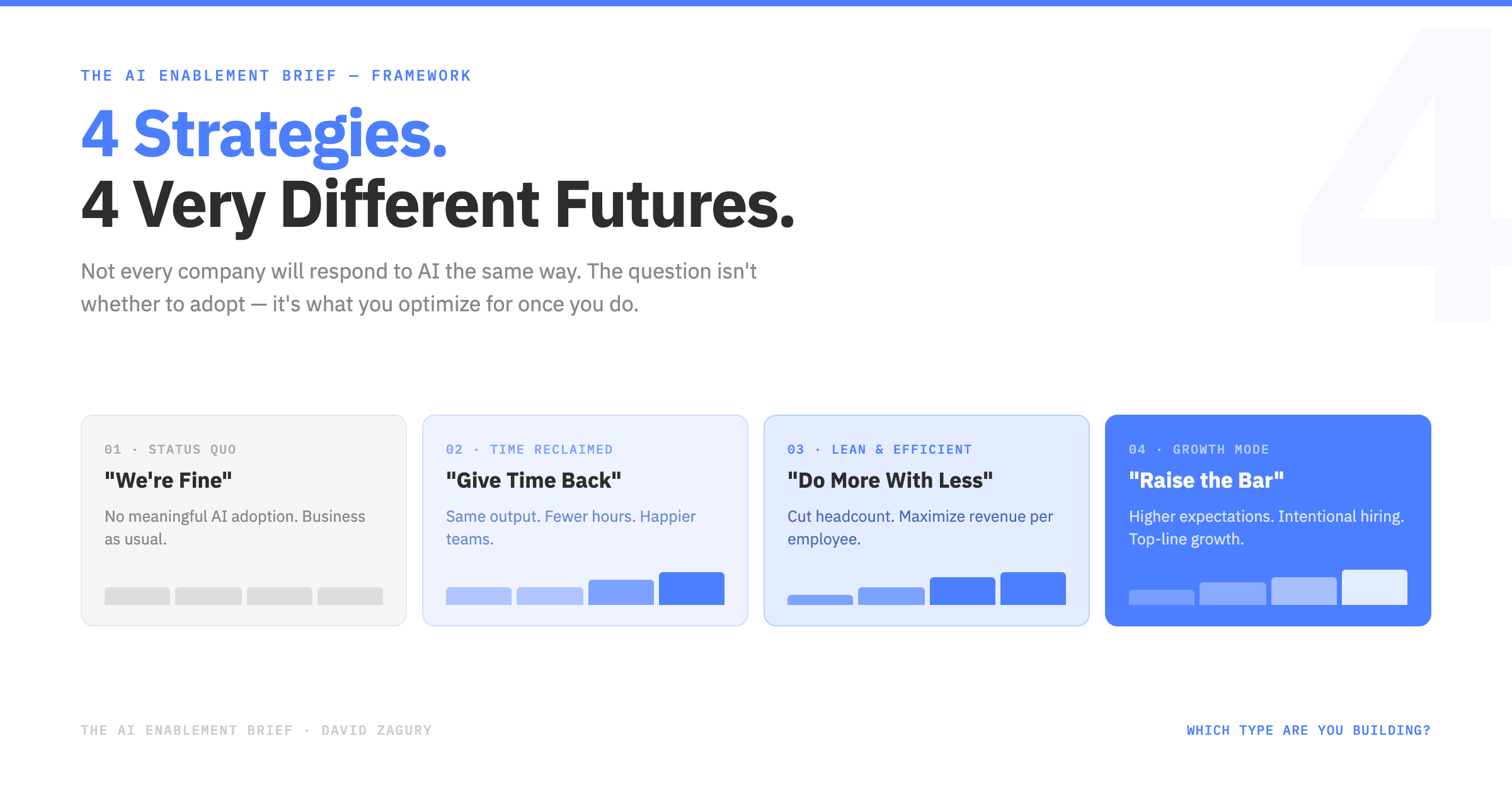
The “We’re Fine” organizations haven’t meaningfully adopted AI. They’re relying on existing processes, existing tools, and existing assumptions about what works. They’ll keep doing business the way they always have — until they can’t.
The “Give Time Back” organizations adopt AI and return the capacity to their employees. Shorter weeks. More flexibility. Same output expectations. This is the work-life balance narrative playing out in practice. It’s not wrong — but it’s not a growth strategy.
The “Do More With Less” organizations cut headcount and run leaner. AI becomes a replacement lever — fewer people doing the same or more work. Same revenue, fewer people, higher revenue per employee. The focus is on margins. Short-term earnings look great. Long-term differentiation? That’s harder to see on a spreadsheet.
The “Raise the Bar” organizations do something different. They look at the same capacity and ask: what could we do that we couldn’t do before? Higher expectations. Higher output. Intentional hiring. If we could pitch 100 clients last year, can we pitch 300 this year — at the same or better quality? That’s the question that changes trajectories.
The Slop Trap
Here’s the thing nobody talks about when they celebrate “AI-powered productivity”: more output isn’t automatically more value.
There’s a version of AI adoption that looks productive on the surface and is quietly destructive underneath. Teams generating more content, more pitches, more reports — but at lower quality, with less original thinking, and with no human judgment in the loop.
I was watching a YouTube video last week from a well-known content creator and agency lead. He mentioned, almost in passing, that his last few articles had been written entirely by AI. And here’s the part that surprised me: I wasn’t even mad about it. Because the quality was good. You couldn’t tell.
That’s the threshold. The question isn’t whether AI touched the work. It’s whether the quality held.
The Slop Trap claims organizations that use AI to do more work, but accept a lower quality bar to get there. Volume without standard. Output without signal. Those organizations will pollute their own reputation faster than any competitor could.
The Quality-Quantity Mandate
The “Raise the Bar” organizations understand something the others don’t: raising output expectations only works if quality rises with it.
This is not easy. It requires a different kind of discipline. Not just “use AI to write faster” — but “use AI to write more, and set a higher bar for what ships.”
Microsoft’s 2024 Work Trend Index found that 77% of AI users say it helps them complete tasks faster. But speed is the easy part. The organizations winning with AI aren’t just faster — they’re shipping work at a quality level that wasn’t possible before, because AI handles the production layer while humans focus on the judgment layer.
That’s the toggle. Production to supervision. Execution to strategy.
It’s the same principle I’ve written about before — but it applies at the organizational level now, not just the individual one.
4 Strategies. 4 Very Different Futures.
Let me be specific about what “Raise the Bar” looks like in practice.
At NP Digital, we’re not thinking about AI as a way to do the same work with fewer people — but as a way to do more of the right work. If a team was capable of producing 10 high-quality strategy decks per quarter before, the question isn’t “can we do 10 with fewer people?” The question is “can we now produce 20 — and what does that unlock for clients?”
That’s the multiplier mindset. And it compounds.
“Raise the Bar” organizations won’t just outperform the others this year. They’ll build capabilities, relationships, and a track record that creates a moat.
While “We’re Fine” companies are still debating AI policy and “Do More With Less” companies are reporting quarterly savings, “Raise the Bar” organizations are pitching twice as many clients, testing twice as many creative strategies, and generating twice as many learning cycles.
The 3-day workweek might be a byproduct — for some. But the organizations that treat new capacity as an invitation to aim higher are going to operate in a different league entirely.
Which type of organization are you building?
Hit reply and let me know.